From Partial Bans to Total Prohibition.

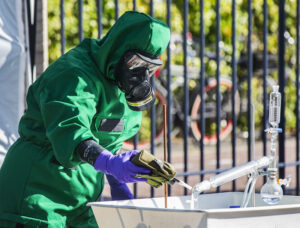
OPCW inspector demonstrates how to gather information and take samples in the field at OPCW; credit OPCW
During World War II, chemical agents were produced en masse, though rarely deployed on the battlefield, mostly due to fear of retaliation. Civilians, however, weren’t spared. Nazi Germany used Zyklon B in the Holocaust, demonstrating how chemical weapons could become tools of genocide. More recently, Saddam Hussein used sarin and mustard gas against Iranian troops and Kurdish civilians during the Iran-Iraq War, culminating in the 1988 Halabja massacre, which killed an estimated 5,000 people.
“The world saw the horror and recognized that piecemeal bans weren’t enough,” Kimball says. “We needed a comprehensive, verifiable, enforceable treaty.”
The resulting CWC banned not only the use, but also the production, accumulation and transfer of chemical weapons. It created a watchdog – the Organisation for the Prohibition of Chemical Weapons (OPCW) – to verify compliance and oversee the destruction of stockpiles.
Since 1997, the OPCW has conducted over 5,000 inspections and overseen the destruction of more than 72,000 metric tons of chemical agents. That includes the final U.S. stockpile, eliminated in July 2023 at the Blue Grass Army Depot in Kentucky.
“The U.S. helped set the norm, and after years of hard work destroying our own chemical stockpiles, lived up to it,” says Kimball. “That’s leadership.”
Revill points to the treaty’s track record on adherence.
“Most countries are in compliance with the CWC,” he says. “Where there are deviations, some of which have been extremely challenging, the OPCW has tools – from technical assistance to firmer measures – to address noncompliance.”
“It’s a model,” Kimball adds. “It showed what global cooperation can achieve when guided by principles and U.S. leadership. We were key to its success.”
During World War II, chemical agents were produced en masse, though rarely deployed on the battlefield, mostly due to fear of retaliation. Civilians, however, weren’t spared. Nazi Germany used Zyklon B in the Holocaust, demonstrating how chemical weapons could become tools of genocide. More recently, Saddam Hussein used sarin and mustard gas against Iranian troops and Kurdish civilians during the Iran-Iraq War, culminating in the 1988 Halabja massacre, which killed an estimated 5,000 people.
“The world saw the horror and recognized that piecemeal bans weren’t enough,” Kimball says. “We needed a comprehensive, verifiable, enforceable treaty.”
The resulting CWC banned not only the use, but also the production, accumulation and transfer of chemical weapons. It created a watchdog – the Organisation for the Prohibition of Chemical Weapons (OPCW) – to verify compliance and oversee the destruction of stockpiles.
Since 1997, the OPCW has conducted over 5,000 inspections and overseen the destruction of more than 72,000 metric tons of chemical agents. That includes the final U.S. stockpile, eliminated in July 2023 at the Blue Grass Army Depot in Kentucky.
“The U.S. helped set the norm, and after years of hard work destroying our own chemical stockpiles, lived up to it,” says Kimball. “That’s leadership.”
Revill points to the treaty’s track record on adherence.
“Most countries are in compliance with the CWC,” he says. “Where there are deviations, some of which have been extremely challenging, the OPCW has tools – from technical assistance to firmer measures – to address noncompliance.”
“It’s a model,” Kimball adds. “It showed what global cooperation can achieve when guided by principles and U.S. leadership. We were key to its success.”


Comments
Post a Comment